APIs
Event Planner API
An events API where the modelling problem is that nothing stands alone: an RSVP only means something in relation to a person, an event and a venue.
The problem
Events, venues, users and RSVPs look like four independent collections until you try to write them. An event without a venue is incomplete, an RSVP pointing at a deleted event is corrupt, and a guest count attached to nobody is meaningless. So the real work is not the CRUD, it is the relationships between records and the validation that keeps them coherent, plus letting a third party sign in without the API ever storing a password.
Approach
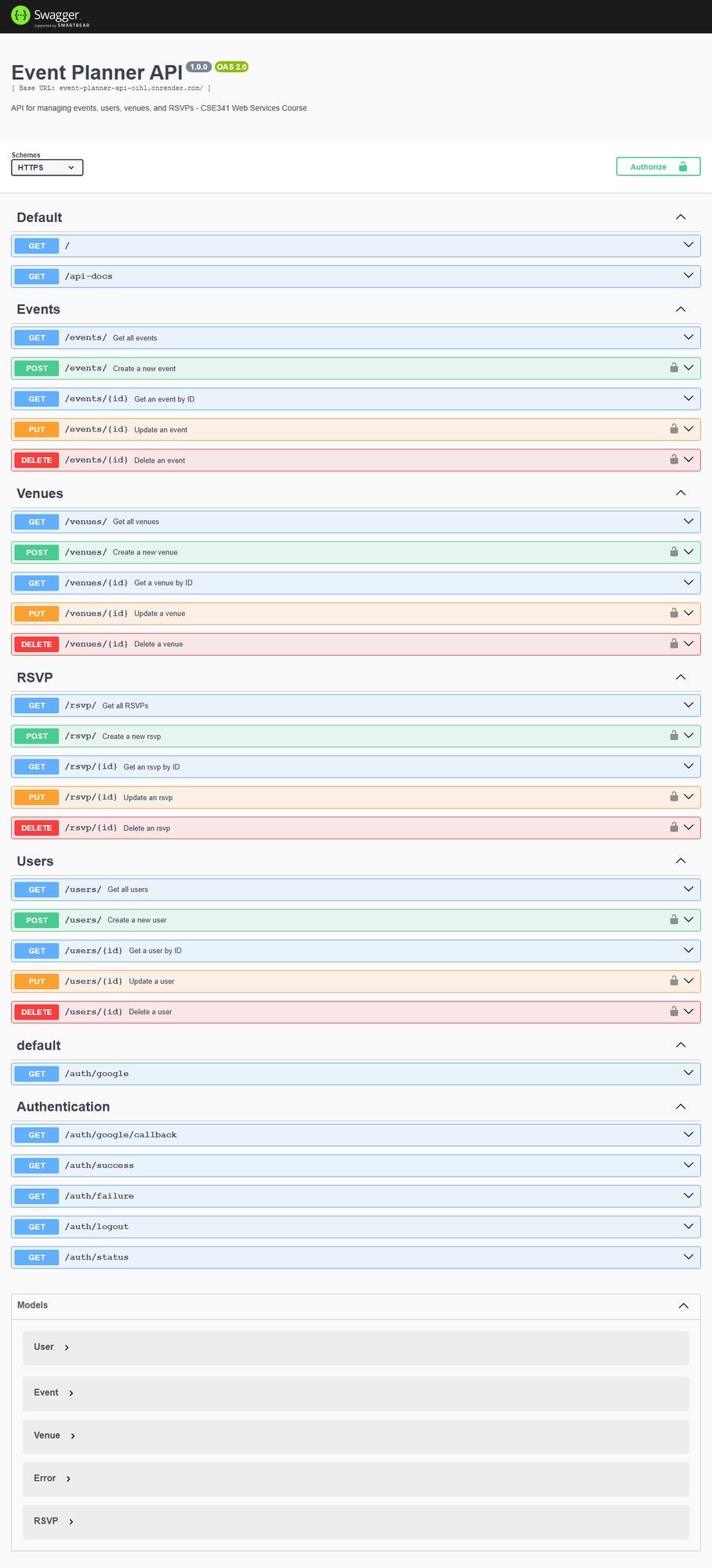
- Sixteen endpoints cover events, venues, users and RSVPs, with the related records referenced by identifier so an RSVP resolves to a real event and an event to a real venue.
- Authentication is delegated to Google via OAuth2, so the API never stores or verifies passwords itself.
- Every write path validates its payload before touching the database, and errors return a consistent shape rather than leaking raw exceptions.
- RSVPs carry their own state (going, interested, not going) plus guest count and an optional note, so attendance is a record with meaning rather than a boolean flag.
- A Jest test suite covers the routes, and the OpenAPI specification is generated from the route definitions instead of written separately.
- The generated reference is published as a static page, so the documented contract stays readable whether or not a server is running behind it.
What it proves
- Sixteen documented endpoints across four related resources.
- Google OAuth2 sign-in, with no password storage in the API.
- OpenAPI specification generated from the routes, published as an always-available static reference.
- Covered by a Jest test suite.